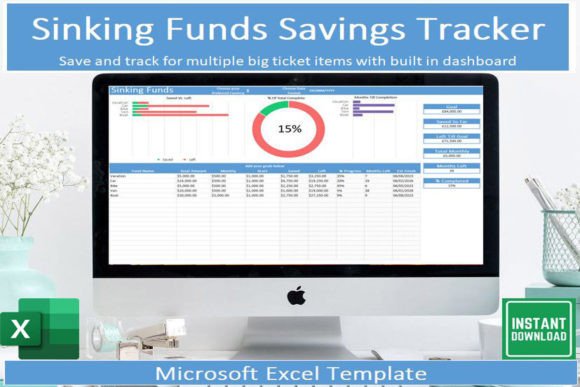
Sinking Funds Tracker I Excel
Managing multiple financial goals simultaneously is one of the most practical challenges professionals and entrepreneurs face. You know you need to save for the next major equipment purchase, a planned business expansion, annual insurance premiums, or perhaps a family vacation — but keeping all those targets organized in your head or across scattered notes rarely works. A structured approach changes that. The Sinking Funds Tracker I Excel spreadsheet offers a methodical way to track progress toward as many as fifteen separate savings goals, all within a single file that works on desktop and mobile devices. When used thoughtfully, this template becomes more than a record-keeping tool; it becomes a strategic planning instrument that supports better decision-making around cash flow, spending priorities, and long-term financial health.
What a Sinking Funds Tracker Actually Does for Your Planning
A sinking fund, in traditional financial terms, is money set aside over time to cover a future expense. The concept is straightforward, but executing it across multiple goals requires discipline and visibility. The Sinking Funds Tracker I Excel template addresses this by providing a centralized dashboard where you define each goal, its total cost, how much you have already saved, your monthly contributions, any extra payments, the remaining amount needed, and an estimated completion date. This structure eliminates guesswork. Instead of wondering whether you are on track for a particular purchase, you can see at a glance where each goal stands relative to its target.
For entrepreneurs and freelancers, this level of clarity is particularly valuable. Irregular income streams make it tempting to treat surplus cash as disposable, but a sinking funds tracker reframes that surplus as an opportunity to accelerate progress on specific goals. When you see that a particular target is ahead of schedule, you can decide whether to redirect funds elsewhere or adjust the timeline. The template also includes a pre-filled example tab, which helps you understand the logic before you enter your own data. This reduces the learning curve and gets you using the tool with confidence almost immediately.
Why Thoughtful Use Supports Better Financial Decisions
Using a tracker without a clear strategy is simply data entry. Using it with intention transforms how you allocate resources. The Sinking Funds Tracker I Excel spreadsheet includes drop-down lists for categorization, which means you can group goals by type — business expenses, personal savings, debt payments, or emergency funds — and then analyze patterns across categories. Over time, this reveals how your spending priorities align with your actual goals. You might discover that you are saving aggressively for a short-term luxury while underfunding a critical business expense due in six months. That insight alone can shift your monthly allocation decisions in a more balanced direction.
The automatically updating graphs and totals remove the friction of manual calculations. When you update a monthly contribution or add an extra payment, the estimated completion date recalculates in real time. This feedback loop is powerful. It allows you to run scenarios: What happens if I increase my monthly contribution by twenty percent? What if I make a lump-sum payment next quarter? You can test assumptions without any risk, then commit to the approach that best supports your current cash position and future needs. This kind of scenario planning is something that most spreadsheets and basic budgeting apps do not offer in such a direct, goal-focused way.
Strategic Applications Across Professional and Personal Contexts
Professionals and small business owners often manage overlapping financial obligations. A sinking funds tracker helps separate those obligations into distinct, manageable lines. Consider a freelance designer who needs to save for new software licenses, a professional development course, quarterly tax payments, and a replacement laptop. Each of these has a different timeline and cost. Without a tracker, it is easy to prioritize whichever expense feels most urgent at the moment, which may not align with long-term needs. With the Sinking Funds Tracker I Excel, the designer can set up each goal, assign a monthly contribution based on priority, and track progress across all four simultaneously.
The ability to change currency and date format at the click of a button also makes this template useful for those who work across markets. If you bill clients in euros but incur expenses in pounds or dollars, you can maintain consistency without maintaining separate files. This is a small feature, but it reduces friction in multi-currency environments. Similarly, the mobile accessibility through the free Microsoft Excel app means you can update contributions on the go — after receiving a payment, before committing to a new expense, or during a periodic review while traveling.
Using the Tracker for Debt Reduction and Savings Simultaneously
One of the most strategic uses of a sinking funds tracker is managing both savings and debt repayment from the same financial plan. Many people treat these as separate activities, but they are fundamentally linked. Every dollar allocated to debt repayment is a dollar not going toward a savings goal, and vice versa. The template allows you to create entries for each debt you want to pay down — treating the outstanding balance as the total cost, your payments as monthly contributions, and the estimated completion date as your payoff timeline. This gives you a single view of your entire financial landscape rather than forcing you to toggle between different tools or mental models.
From a decision-making standpoint, this unified view helps you answer trade-off questions more objectively. If you have an opportunity to allocate a bonus or unexpected revenue, you can look at the tracker and see which goal has the nearest deadline or the highest momentum. You might decide to accelerate a debt with a high interest rate, or you might choose to complete a savings goal that unlocks a business opportunity. The tracker does not tell you which choice is correct, but it provides the data you need to make that choice with full context. That is the difference between reactive financial management and intentional financial strategy.
Practical Planning Tips for Getting the Most Out of the Template
To use the Sinking Funds Tracker I Excel spreadsheet effectively, start with the pre-filled example tab. Review how the example goals are structured — what information goes into each column, how the drop-down categories are applied, and how the graphs update based on the data. This takes five minutes and prevents confusion later. Then, create your own entries. Begin with no more than five goals, even though the template supports up to fifteen. A smaller starting set allows you to verify that your monthly contributions are realistic and that the estimated dates align with your expectations. You can add more goals as you become comfortable with the rhythm of updating the tracker regularly.
Set a recurring review schedule. Weekly might be too frequent for most people, but monthly is usually appropriate. During each review, update your saved-so-far amounts, adjust monthly contributions if your income has changed, and note any extra payments you made. The template's automatic recalculations will then show the updated timeline. Over several months, this habit builds a reliable historical record. You can look back and see how your savings velocity changed over time, which months were stronger, and which goals required more discipline. That historical perspective is invaluable for planning future goals with greater accuracy.
Consider sharing the tracker with a partner, business partner, or accountability partner. Financial goals are easier to maintain when someone else can see progress. The spreadsheet format makes sharing straightforward — either through cloud storage with shared access or by sending a copy periodically. The transparency encourages honest conversations about priorities and trade-offs, which is especially important in joint business ventures or household financial management.
What to Watch Out for When Relying on Any Tracker
No tracker, no matter how well designed, substitutes for realistic goal setting. The Sinking Funds Tracker I Excel will calculate an estimated completion date based on the numbers you enter, but if those numbers are optimistic — if your monthly contribution is higher than your actual surplus, or if you underestimate the total cost — the date will be misleading. The tool is only as accurate as the data you feed it. This is why starting with conservative estimates and adjusting upward as you prove you can sustain the pace is a wiser approach than aiming for aggressive targets that you cannot maintain.
Another risk is tracking too many goals at once. The template supports up to fifteen items, but managing that many simultaneously can create cognitive overload. You might spread your monthly surplus so thinly across fifteen goals that none of them feels like it is making meaningful progress. In practice, most people benefit from focusing on three to seven active goals at any given time. The remaining slots can be used for goals that are on hold or planned for a future quarter. This keeps the active list manageable and the progress visible, which in turn sustains motivation and discipline.
Finally, be careful about treating the estimated completion date as a hard deadline. Life and business are unpredictable. Revenue fluctuates, expenses emerge, and priorities shift. The date is a projection based on current assumptions. It gives direction, but it is not a promise. When the date shifts — and it will — update the data and keep moving. The value of the tracker is not in predicting the future perfectly; it is in giving you a clear picture of where you stand today and what it will take to reach your target under current conditions. That clarity alone improves your odds of following through.
Long-Term Value Beyond the Initial Setup
The real return on investing time in a sinking funds tracker comes after several months of consistent use. You build a data history that reveals your actual savings patterns, not just your intentions. You learn which categories you consistently prioritize and which ones you tend to neglect. You develop a more accurate sense of how much surplus you truly generate each month, because the tracker forces you to account for every goal. Over time, this awareness changes how you think about money. Instead of seeing savings as whatever is left after expenses, you start to see expenses as whatever remains after savings. That inversion is a hallmark of mature financial management.
For professionals and entrepreneurs who operate in environments where cash flow is irregular and opportunities are time-sensitive, having a sinking funds tracker ready means you can act faster when an opportunity arises. If a piece of equipment goes on sale unexpectedly, you can check your tracker to see whether you have enough saved for that specific goal. If a training program offers a limited-time discount, you can see whether you can reallocate funds from another goal without derailing your overall plan. Speed of decision-making, in those moments, depends on having accurate, up-to-date information at your fingertips. The Sinking Funds Tracker I Excel spreadsheet provides exactly that — in a format that you control, that does not require internet access to view, and that adapts to your preferred currency and date format with a single click.
There is also a less tangible benefit: the sense of clarity and control that comes from knowing exactly where you stand. Financial anxiety often stems from ambiguity — from not knowing whether you are on track or falling behind. A regularly updated tracker removes that ambiguity. It replaces worry with data. It turns vague concerns into specific action items. That shift in mindset, over time, supports better decision-making across every area of your professional and personal life, not just the financial one.