Journalist Characters: Strategic AI EPS Illustrations for Purposeful Visual Communication
When you are building a brand, a campaign, or a curriculum, the visual language you choose matters. Every illustration, every icon, and every character shapes how your audience perceives your message. Journalist Characters is an AI EPS illustration set that offers more than a quick graphic asset. It provides a consistent, editable, and strategically useful toolkit for professionals who need to communicate with clarity and credibility. Whether you are an entrepreneur launching a news-related service, a marketer designing a media kit, or an educator creating infographics about journalism, this collection supports your goals without forcing you to compromise on quality or consistency.
The Strategic Role of Visual Characters in Communication
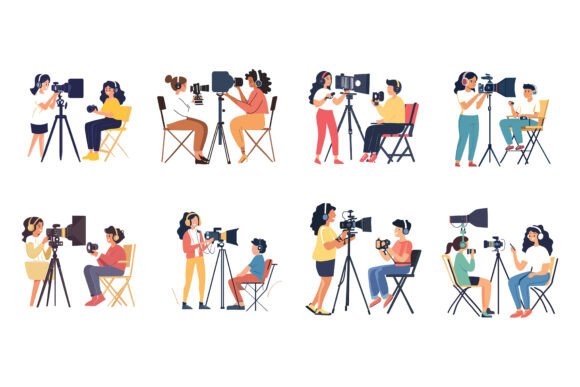
Characters in illustrations serve as proxies for real people, values, and narratives. When you choose a set like Journalist Characters, you are not merely selecting clip art. You are defining a visual persona that can appear across your website, print collateral, social media, and presentations. This consistency reinforces trust and recognition. For decision-makers, the strategic question is not “Is this illustration cute?” but “Does this character align with the tone, audience, and objective of my project?” A reporter with a notepad and microphone can signal authority, curiosity, and accuracy. A news anchor behind a desk can evoke reliability and professionalism. By using a dedicated collection, you ensure that every character shares a consistent style, perspective, and level of detail. This avoids the disjointed look that comes from mixing illustrations from different sources.
From a planning perspective, Journalist Characters allows you to map out visual assets in advance. Instead of searching for a suitable newsroom scene or an interview moment, you can plan your entire visual narrative around the set. You know exactly what poses, environments, and tools are available. This makes editorial calendars, marketing timelines, and content strategies more predictable and less frantic. The file structure in AI EPS format is neatly organized, which means your design team can locate the right layer, adjust colors, or modify a posture without redoing the entire graphic. This operational efficiency directly impacts productivity and reduces the friction between idea and execution.
Why a Dedicated AI EPS Collection Supports Better Branding
Branding thrives on repetition and refinement. Every time you use a Journalist Characters illustration, you reinforce a specific aesthetic. Because the set includes AI, EPS, and JPG formats, you can use the same character on a large billboard and a small app icon while maintaining crispness. For entrepreneurs and small business owners who may not have a full-time designer, this scalability is critical. You invest once and then reuse across multiple channels. The ability to change colors easily means you can match your brand’s primary palette without needing advanced design skills. If your brand evolves, you can update the illustrations to reflect the new color scheme, keeping your visual identity fresh without purchasing a new collection.
Moreover, the consistency in details and proportions ensures that if you use multiple characters together—say a reporter interviewing a citizen—they will look like they belong in the same universe. This coherence is something that generic stock illustration libraries rarely offer. When your audience sees your materials, they subconsciously register that your visuals are intentional. Over time, that builds a perception of professionalism and reliability, which directly supports your long-term positioning.
When to Use Journalist Characters and How to Approach It
Journalist Characters is most strategically useful when your content involves news, media, communication, storytelling, or education. Consider these use cases:
- Website hero sections for a journalism startup, a media training company, or a news aggregator app.
- Infographics that explain reporting processes, press freedom, or media literacy.
- Social media posts announcing a press release, a podcast episode, or a live coverage event.
- Presentations for conferences, corporate training, or investor pitches about media ventures.
- E-learning modules about journalism where characters help illustrate scenarios.
- Print materials like brochures, flyers, or annual reports for media organizations.
When approaching the set, start by reviewing the available poses and elements. Identify which characters best represent the roles you need: reporter, anchor, photographer, editor, interviewee. Each character should serve a specific narrative function. Avoid the temptation to use every illustration at once; selective use maintains visual impact. Plan your layouts so that characters guide the reader’s eye to key information. For example, a journalist pointing at a headline can draw attention to a statistic or a call to action.
Practical Planning Tips for Integrating the Set
Before you open the file, define your goals. Are you trying to increase engagement on a landing page? Educate an audience about a complex topic? Build trust for a new media brand? The answer will influence which characters you emphasize and how you customize them. Because the set is fully editable, you can adjust the characters’ expressions, colors, and accessories to better fit your message. A reporter holding a microphone can be changed to hold a smartphone if your content focuses on digital journalism. You can also combine characters with other vector elements from your own library, as long as the style remains consistent.
Consider the context of your audience. If you are creating materials for a professional conference, you might want the characters to appear in business attire. If you are targeting a younger demographic for a media literacy program, you could use more casual poses. The AI EPS format gives you the freedom to make these adjustments without starting from scratch. This flexibility is especially valuable for marketers and educators who need to iterate quickly based on feedback or results.
Strategic Observations: Consistency, Credibility, and Long-Term Value
One of the less obvious advantages of a defined illustration set like Journalist Characters is the discipline it imposes. When you know that every character shares the same line weight, color palette, and level of detail, you naturally plan your layouts more consistently. This forces you to think about placement, negative space, and hierarchy. Over time, this design discipline can improve your overall visual communication skills. For freelancers and small teams, this is a low-risk way to produce professional-looking assets that would otherwise require hiring a custom illustrator.
The file organization also supports operational efficiency. Because the layers are neatly structured, you can hand off the files to a designer, a colleague, or even a future version of yourself. The project remains maintainable and scalable. If you need to create a series of social media cards, you can reuse the same character in different settings without losing quality or consistency. This reduces the time spent on each new asset, which directly contributes to productivity and allows you to focus on strategy rather than production.
Risks of Using Journalist Characters Without Clear Context
Even a well-designed set can undermine your goals if used carelessly. The primary risk is that the illustrations feel generic or out of place. If your brand is edgy, minimalist, or highly abstract, a realistic journalist character might clash with your overall aesthetic. Another risk is overuse. If every single page of your website features the same reporter in a different pose, the visuals can become repetitive and lose their impact. Dilution of meaning is also a concern: a journalist character placed in a context unrelated to news or communication can confuse your audience. For example, using it on a page about financial services might imply media coverage of finance rather than the service itself, leading to misinterpretation.
To avoid these risks, always ask: What story does this character tell in this specific context? Does it support or distract from the main message? If the answer is not clear, consider omitting the illustration or using it in a less prominent position. Also, consider the cultural connotations of journalists in different regions. The characters should represent the values of your target audience, not create unintended stereotypes or biases. When in doubt, test the visuals with a small sample of your audience to gauge their reaction.
Decision-Making Guidance: Is Journalist Characters Right for Your Project?
To decide whether to invest in this set, evaluate your current and future content needs. If you consistently produce content about media, news, communication, or journalism, then having a dedicated collection will save you time and ensure a cohesive look. If your work occasionally touches these topics, the set can still be useful, but only if you have a plan to reuse it across multiple projects. For one-off projects, it may be more cost-effective to purchase a single illustration from a stock site, but you lose the consistency advantage.
Consider also the skill level of your team. If you or your team are comfortable with vector editing software, the AI EPS format gives you full control. If not, the included JPG previews can be used as they are, but you sacrifice the ability to customize colors and sizes without degradation. In that case, you might want to hire a designer to do the initial modifications, then use the edited versions for the long term. This approach still provides a solid return on investment if you plan to use the illustrations extensively.
Lastly, think about the lifetime of your brand. If you are building a media startup or a journalism education platform, visual consistency over months and years contributes to brand equity. Journalist Characters can become a recognizable part of your identity, especially if you customize them to include unique elements like your logo colors or proprietary accessories. As your content library grows, each new illustration reinforces the previous ones, strengthening the overall brand memory in the minds of your audience.
Putting the Set to Use: A Quick Workflow Example
Assume you are launching a series of social media posts about media literacy. You want each post to feature a journalist character explaining a key concept. Start by extracting the most relevant poses: a reporter holding a notepad, a podcast host, and a photographer. Open the AI file in your vector software. Adjust the color palette to match your brand colors. Crop the characters to focus on the upper body if you plan to include a text overlay. Export each as a PNG for social media. Because the layers are organized, you can hide or rename elements easily. Over a series of ten posts, the characters create a visual thread that boosts recognition and engagement. If one post underperforms, you can modify the character’s expression or background without redoing the entire design.
This workflow demonstrates how Journalist Characters supports both creativity and productivity. The initial effort to set up the templates pays off with each subsequent use. For entrepreneurs and marketers who are constantly balancing multiple initiatives, this kind of leverage is invaluable. The set is not a magic solution, but it is a reliable tool that, when used with intention, can elevate your visual communication and help you achieve better outcomes over time.
Ultimately, the decision to use Journalist Characters should be based on your strategic needs, not just on the availability of a new asset. Evaluate your content calendar, your brand guidelines, and your audience expectations. If the set aligns with all three, then it becomes a practical investment in your communication infrastructure. Start with a small test—use one character in a few settings—and observe the response. From there, you can scale up your usage, confident that the visuals are supporting your goals rather than distracting from them.