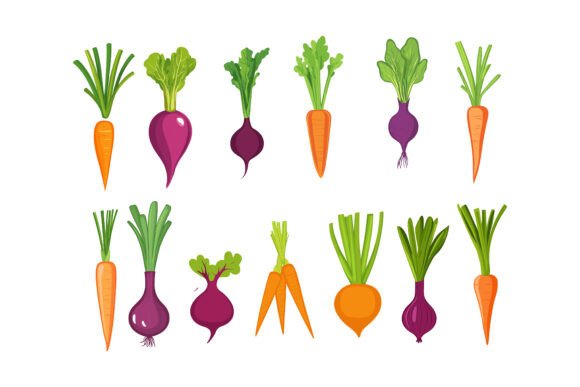
The Definitive Collection of Taproot Vegetables in Vector Illustration
Root vegetables have long held a central place in agriculture, cuisine, and visual culture. Among them, taproot vegetables—characterized by a single, thick central root that stores nutrients—offer a striking diversity of shapes, colors, and textures. Carrots, beets, radishes, parsnips, turnips, and celeriac are just a few examples. For designers, educators, and content creators, representing these vegetables accurately and attractively is essential for everything from branding to educational materials. A comprehensive set of different taproot vegetables, rendered in high-quality vector format, provides an invaluable resource. With the right illustration set, you gain access to a library of botanical art that is both beautiful and functionally versatile.
Understanding Taproot Vegetables and Their Visual Significance
Taproot vegetables grow by funneling energy into a dominant root that can be long, bulbous, or tapered. This morphological variety makes them visually distinct and immediately recognizable. Carrots exhibit a classic elongated taper; beets present a rounded, bulbous form with leafy tops; radishes range from small, round cultivars to long, white daikon varieties. Each offers a unique silhouette and texture that can be leveraged in design projects. The visual significance of these vegetables extends beyond mere representation—they evoke freshness, health, earthiness, and culinary tradition. For an illustrator or graphic designer, having a set of different taproot vegetables at your fingertips means you can quickly assemble a cohesive visual narrative around farming, nutrition, or seasonal cooking, without needing to source or photograph each specimen individually.
What Makes This AI EPS Illustration Set Exceptional
The value of any illustration set lies in its technical quality, consistency, and ease of use. This particular collection has been crafted with several key attributes that elevate it above generic clip art. The file includes both AI EPS and JPG formats, ensuring compatibility across all major design environments. Whether you are working on a Mac or Windows platform, the files are designed to open seamlessly in Adobe Illustrator, CorelDRAW, or similar vector editing software. Each illustration is organized into neat, clearly labeled layers, making it simple to isolate elements, adjust compositions, or repurpose individual components.
Perfection in details and consistency is evident throughout the set. The lines are crisp, the gradients smooth, and the proportions botanically accurate. This level of detail supports both high-fidelity print output and crisp on-screen viewing. The set is suitable for a wide range of mediums—print, web, symbols, apps, and infographics. Because the illustrations are vectors, they can be scaled without losing resolution, which is indispensable for everything from a tiny app icon to a large poster. You can edit it, change colors, and modify the icon so easily according to your needs, thanks to the well-structured path data and ungrouped objects.
Practical Applications Across Industries
The versatility of a taproot vegetable illustration set makes it useful for numerous professional contexts. In the food industry, restaurants, cookbooks, and food bloggers use these images to create menus, recipe cards, and social media graphics that emphasize natural, farm-to-table values. An organic grocery store might use the set to design shelf labels, promotional flyers, or website banners that highlight their root vegetable selection. For educators, the illustrations serve as clear, approachable visuals for lessons on plant biology, nutrition, or agriculture. A school biology teacher could incorporate the images into a worksheet about root systems, while a nutritionist might use them in an infographic about vitamin-rich vegetables.
Researchers and authors also benefit from such a set. When publishing a guide on heirloom vegetables or a book on seasonal cooking, having a curated collection of taproot vegetables ensures that every illustration maintains a consistent visual style. This consistency builds trust and professionalism. Hobbyists and home gardeners can use the graphics for personal projects such as garden planners, seed packet labels, or decorative prints for a kitchen. Business owners, especially those in farming or food retail, can integrate the illustrations into their branding to create a cohesive, earthy identity that resonates with customers seeking natural products.
Tailoring the Illustrations to Your Creative Workflow
One of the most significant advantages of this AI EPS set is how easily it integrates into existing creative workflows. Designers who rely on Adobe Illustrator appreciate the layered structure, which allows for rapid customization. You can recolor a beet to match a brand palette, alter the shape of a carrot to fit a specific composition, or combine multiple vegetables into a single infographic without redrawing anything. The JPG version offers a quick preview option for clients or for use in non-editable contexts, such as presentations or wireframes.
The set is also ideal for team environments where different members use different operating systems. Because the files are designed for both Mac and Windows users, no compatibility issues arise during handoffs. The organized file and layer structure further streamlines collaboration: an art director can quickly identify which layer contains the leaf detail of a parsnip, while a junior designer can safely make color adjustments without breaking the illustration. This efficiency saves time and reduces the friction often associated with using third-party assets in professional production.
Comparative Advantages for Different User Groups
Each user group derives specific benefits from owning a comprehensive taproot vegetable set. For a graphic designer, the main advantage is time saved. Searching for individual vegetable vectors, ensuring they match stylistically, and fixing inconsistent scales can take hours. With this set, everything is harmonized out of the box. For educators, the advantage lies in accuracy and clarity. The illustrations depict realistic forms that support learning objectives without being overly stylized. A radish looks like a radish, complete with its fine root hairs and characteristic leaf structure.
Business owners, particularly those in the organic food sector, benefit from the professional polish these illustrations bring to marketing materials. High-quality visuals correlate with perceived product quality, and a cohesive set of root vegetable graphics can elevate a brand's visual language. Hobbyists appreciate the creative flexibility: they can resize, recolor, and rearrange components to make unique artwork for personal gifts, home decor, or online shops. Researchers and technical writers find the set useful for generating consistent figures for publications, presentations, or grant proposals, without needing to commission custom illustrations.
Quality Considerations and Asset Management
When investing in an illustration collection, quality and longevity matter. This set stands out because every asset has been refined to ensure perfection in details and consistency across the entire series. The color palettes are natural yet flexible, allowing for easy recoloring using Illustrator's global color swatches or direct selection tools. The lines are clean, with no stray anchor points or overlapping paths that could cause printing errors or rendering glitches.
The set also lends itself well to long-term asset management. Because the files are organized and clearly named, you can build a library of taproot vegetable illustrations that you reuse across multiple projects over years. As trends shift, you can update colors or styles without starting from scratch. The inclusion of both EPS and JPG means you have a lossless vector master and a raster preview side by side. This dual-format approach is a best practice for anyone who maintains a professional visual asset library.
Integrating Taproot Vegetable Graphics into Real-World Projects
To understand the practical impact of such a set, consider a few concrete examples. A small organic farm wants to create a series of recipe cards for its CSA subscribers. Using the illustrations, the farm can design cards featuring roasted carrots, beet salad, and parsnip soup—all with a consistent visual style that reinforces their brand identity. The editable nature of the files allows them to add their logo, change background colors, and adjust positions without needing a professional designer on staff.
Another example is a college creating an online module on root crops for an agricultural studies course. The instructor can use the illustrations to build an interactive infographic showing the structure of a taproot versus a fibrous root system. The set's consistency ensures that the visual examples all belong to the same scientific illustration family, making the content more credible and easier to follow. A third scenario involves a food blogger who uses the vector files to create seasonal headers for their website, changing the featured vegetable with each new post. The flexibility to quickly swap a radish for a turnip makes content creation faster and more visually engaging.
The Role of Vector Illustrations in Modern Content Creation
Vector illustrations have become a cornerstone of modern digital and print content. Their scalability, small file size, and editability make them superior to raster images for many applications. In the context of taproot vegetables, vector art allows creators to produce sharp, clean visuals that work equally well on a smartphone screen and a billboard. The ability to modify colors, resize without quality loss, and combine elements from different illustrations empowers designers to produce unique compositions without endless manual drawing.
Trends in content marketing increasingly favor authentic, handcrafted visuals over stock photography. Vector illustration sets bridge that gap: they offer the handcrafted aesthetic with the repeatability and consistency of a curated collection. For businesses in the food and wellness space, using a set of different taproot vegetables in their graphics signals attention to detail and a connection to natural, whole foods. This subtle branding advantage can differentiate a company in a crowded marketplace.
Building a Robust Visual Library
Any serious creator, designer, or educator knows that a well-curated visual library accelerates workflow and improves output quality. Adding this set of taproot vegetable illustrations to your collection means you are always prepared to produce content related to gardening, healthy eating, recipes, botanical education, or agricultural marketing. The combination of file formats, cross-platform compatibility, and user-friendly layer structure makes this set a smart addition, whether you are a solo freelancer or part of a large creative team.
The practical understanding gained from working with such a set extends beyond the immediate project. Each time you edit a color, rearrange layers, or combine illustrations, you deepen your fluency with vector workflow. This translates to faster turnaround times, more confident design decisions, and ultimately better creative output. For hobbyists, it opens doors to professional-looking results without a steep learning curve. For professionals, it saves billable hours that would otherwise be spent on asset creation or cleanup.
When you explore the set of different taproot vegetables included in this collection, you will find each element has been designed with real-world use in mind. The leaves, roots, and cross-sections are all accounted for, offering multiple viewpoints and compositional options. The file structure is intuitive: the main illustrations are separated into logical groups, and the naming conventions are descriptive, so you never waste time hunting for a specific asset. You can easily modify an icon to match your color scheme, adjust proportions to fit a layout, or isolate a single vegetable to use as a button or badge.
From the first moment you open an AI file, the thoughtfulness of the organization becomes apparent. Layers are labeled by vegetable type, part (root, leaf, whole), and color group. This means you can quickly turn off a layer to preview an alternative arrangement or apply a global color adjustment across all carrots while keeping beets unchanged. The precision of the vector paths also ensures that when you scale a radish to fill a page, its fine details remain crisp. Such quality is essential for print collateral like brochures, posters, and merchandise, where pixelation or jagged edges undermine professionalism.
Ultimately, working with a high-quality illustration set transforms the creative process from a search for assets into a session of composition and refinement. The vegetables are ready to be placed, adjusted, and animated (if needed) without any pre-editing. This immediacy is especially valuable for time-sensitive projects such as seasonal menus, holiday promotions, or educational modules that follow the academic calendar. Having a reliable set of taproot vegetable graphics means you can focus your energy on the message and the layout rather than the fundamentals of drawing each root correctly.
Whether you are illustrating a children's book about gardening, designing packaging for a root vegetable snack, or creating a series of informative posts for a nutrition blog, the right assets make all the difference. This collection delivers not just files but a foundation for creative exploration. The editors, designers, and educators who invest in such a set find that it quickly becomes one of their most-used resources. The combination of accuracy, aesthetic appeal, and practical flexibility ensures that every project benefits from the natural beauty and structural charm of taproot vegetables.