Evaluating the Several Ambulances AI EPS Illustration Set
When building a visual library for emergency services, healthcare communication, or public safety content, the choice of illustration assets can significantly affect both production speed and message clarity. The Several Ambulances AI EPS collection presents itself as a specialized resource for designers, developers, and content creators who need accurate, editable ambulance-themed graphics. This article provides an objective evaluation of the set, helping you assess whether it aligns with your project requirements, workflow preferences, and practical constraints.
What the Several Ambulances Collection Offers
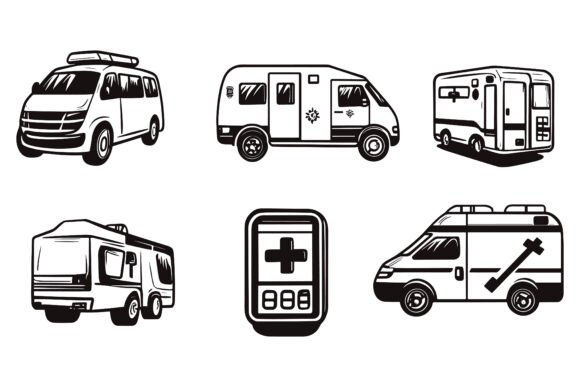
The Several Ambulances set is a curated bundle of vector illustrations centered on ambulance vehicles and related emergency response imagery. The package includes files in three common formats: AI (Adobe Illustrator), EPS (Encapsulated PostScript), and JPG. This format selection is designed to serve users across both Mac and Windows operating systems without compatibility issues. The collection emphasizes organization: the file and layer structures are described as neatly arranged, which can streamline editing for anyone who needs to adapt colors, resize elements, or modify specific components without rebuilding artwork from scratch.
Each illustration is intended to maintain consistency in style and detail, making the set suitable for projects that require a unified visual language. The assets are described as suitable for print, web, symbols, mobile applications, and infographics. This flexibility suggests that the illustrations were constructed with scalability and clean outlines, though actual performance depends on the original vector complexity and the chosen output medium.
Key Features and Their Practical Implications
To evaluate whether the Several Ambulances set meets your needs, it helps to examine each claimed feature in the context of real design workflows.
Format Accessibility and Cross-Platform Use
The presence of AI and EPS files is significant for professional designers who work within Adobe Creative Suite or other vector editing applications. EPS serves as a widely supported interchange format, while AI files preserve native layer structure and editability for Illustrator users. The inclusion of JPG provides a quick preview or raster option for non-editable use cases. For teams that collaborate across different operating systems, the cross-platform compatibility (Mac and Windows) removes a common friction point. However, users of alternative vector editors such as Affinity Designer or Inkscape should verify that EPS imports preserve layer hierarchy, as some applications handle EPS data differently.
File and Layer Organization
A neatly organized layer structure is often undervalued until a project requires late-stage edits. In the Several Ambulances set, the claim of a tidy file and layer structure suggests that components such as wheels, body panels, lights, and text elements are separated logically. This organization enables a designer to adjust the ambulance color scheme, swap out a siren light shape, or reposition labels in seconds rather than tracing through merged paths. For teams that hand off files between designers or need to enforce brand guidelines, this structure reduces error rates and saves time. The tradeoff is that not all designers use layers with the same naming conventions, so a brief familiarization period may still be necessary.
Detail Consistency and Perfection
Consistency in detail can be a decisive factor when building a series of graphics—for example, a set of icons for a hospital website or a sequence of infographic panels about emergency response procedures. The Several Ambulances collection promises "perfection in details and consistency," which implies that line weights, shading styles, color palettes, and proportions are uniform across all files. If this promise holds, the set allows you to create composite layouts without visual friction. On the other hand, "perfection" is subjective. A designer accustomed to hyper-realistic illustration may find the style too abstract, while a developer needing minimalist symbols may appreciate the moderate detail level. It is advisable to examine sample files before purchase to confirm the aesthetic matches your brand or message.
Situations Where This Set Performs Well
Understanding where the Several Ambulances collection shines can help you decide if it is the right tool for your current project.
Emergency Services Communication
If you are creating content for emergency medical services, public health campaigns, ambulance company websites, or training materials, this set provides ready-made imagery that communicates the subject instantly. The specialized focus means you avoid the generic ambulance graphics found in broad icon sets, which often lack accurate vehicle proportions or fail to represent modern ambulance designs. For a medical transportation company's brochure, the illustrations can be edited to match fleet colors, making the material feel custom without the cost of a full illustration commission.
Mobile and Web Applications
For app developers building emergency alert systems, first responder coordination platforms, or healthcare locator tools, vector icons at multiple scales are essential. The AI and EPS formats allow you to export at various resolutions without quality loss, and the layer organization makes it feasible to create light and dark mode variants by simply recoloring specific layers. The set also supports the production of symbols and tokens for design systems, provided that the illustration style aligns with your existing UI components.
Infographics and Educational Materials
Educators and public information officers who produce infographics about emergency response times, ambulance equipment, or safety procedures will benefit from the consistent visual style. Having a cohesive set of ambulance illustrations reduces the distraction caused by mismatched iconography in educational materials. The ability to edit colors and labels means you can highlight specific parts of the vehicle without redrawing it entirely, which is especially useful when creating a series of diagrams for a single campaign.
Print Projects Requiring Scalability
For posters, flyers, banners, or vehicle wraps, vector illustrations are the standard because they scale to any size. The Several Ambulances set is advertised as suitable for print, and if the illustrations are constructed with appropriately closed paths and sufficient resolution at the source, they should reproduce cleanly at both small and large dimensions. However, always test a sample output at your target print size to confirm edge sharpness and color fidelity.
Tradeoffs and Considerations
No single illustration set is ideal for every scenario. The Several Ambulances collection has limitations that you should weigh against your specific needs.
Limited Subject Scope
The most obvious tradeoff is the narrow subject focus. If your project covers a broad range of emergency vehicles—including fire trucks, police cars, helicopters, or rescue boats—this set alone will not cover those needs. You may need to supplement with another collection or create additional assets from scratch. This specialization is an advantage if you need only ambulance imagery (you pay only for what you use), but it becomes a drawback if your content requires a complete emergency response ecosystem.
Style Specificity
The illustration style is predefined. While you can change colors and make modifications, the fundamental art style—whether flat, geometric, semi-realistic, or minimalist—is fixed. If your brand or project demands a highly distinctive aesthetic (e.g., hand-drawn sketch style, 3D rendered look, or isometric perspective), this set may not align. Always preview the style thoroughly. Some marketplaces offer sample files or watermarked previews that allow you to assess the style before purchase.
Editability Versus Locked Elements
The claim that you can "edit it, change colors and modify the icon so easily" depends on how the files were constructed. In well-made EPS and AI sets, elements are grouped logically and layers are named clearly. However, some sets use compound paths or clipping masks that can frustrate editing attempts. If you plan to heavily customize the illustrations, verify that the source files are as editable as advertised. Look for reviews or descriptions that mention the level of vector path openness.
File Size and Application Performance
High-detail vector illustrations can sometimes produce large file sizes, especially when gradients, patterns, or multiple anchor points are used. This may slow down performance in older hardware or in applications that handle many linked files simultaneously. For web and mobile use, you will likely export the vectors to lightweight formats (SVG, PNG, or WebP), so the AI source size is less critical. For print, file size is usually not a concern, but check that your system can handle the native files comfortably.
When Alternatives May Be Worth Considering
For some projects, the Several Ambulances collection might not be the optimal choice. Recognizing these scenarios can save you time and budget.
Expansive Icon Sets for General Use
If you need a comprehensive icon library that covers multiple industries—including healthcare, transportation, safety, and business—a general icon set such as Font Awesome, Material Design Icons, or a premium vector bundle with thousands of symbols may deliver better value. These sets often include an ambulance icon alongside hundreds of other symbols, providing consistency across an entire product interface at a lower per-icon cost.
Custom Illustration for Brand Identity
For organizations with a unique brand identity that demands original artwork, buying a stock illustration set may not achieve the desired distinctiveness. A freelance illustrator or agency can create custom ambulance graphics that match your exact brand guidelines, incorporate specific vehicle models, and convey your tone of voice. This route is more expensive and time-consuming but yields differentiated assets that no competitor can replicate.
Real Photography for High Impact
In certain contexts—such as news articles, annual reports, or fundraising campaigns—authentic photography of real ambulances and emergency personnel can create a stronger emotional response than illustrations. Realism conveys urgency, professionalism, and authenticity in ways that vector art sometimes cannot. If your audience expects documentary-level visual evidence, consider supplementing or replacing illustrations with licensed stock photography or original photos.
Motion Graphics or 3D Projects
This set provides static vector illustrations. If your project requires animated ambulance graphics for video, interactive web experiences, or 3D modeling, you will need to either animate the vector layers yourself or purchase purpose-built assets in formats such as SVG animations, Lottie files, or 3D model formats (OBJ, FBX, etc.). The Several Ambulances set can be used as a base for animation (by separating moving parts), but that requires extra work and may not be as efficient as buying pre-animated assets.
Practical Decision-Making Insights
To determine whether the Several Ambulances collection aligns with your goals, consider the following evaluation framework.
Start with your project's scope. List all the visual subjects you need to illustrate. If ambulances represent the majority of your imagery, this set is a strong candidate. If you need a broader range of vehicles or medical equipment, assess how much supplementary work you are willing to do.
Assess your editing requirements. How much customization do you plan to apply? If you simply need to drop in ready-made graphics with minimal color changes, the set is likely sufficient. If you expect to modify vehicle proportions, add realistic lighting effects, or restructure the entire composition, ensure the source files offer the necessary openness. Requesting a sample file from the seller (if available) is a low-risk way to verify editability.
Evaluate the style against your brand guidelines. Gather a few representative samples of your current visual content. Compare the illustration style—line thickness, use of shading, color temperature, level of detail—to the Several Ambulances examples. A consistent fit will save time on post-processing and avoid a mismatched visual identity.
Consider your delivery formats. The set supports AI, EPS, and JPG. If your final output requires SVG, PDF, or PNG, you can easily export from the source formats. If your pipeline demands specific file types (e.g., Figma components, Sketch symbols, or Adobe XD assets), you may need to convert the files. EPS import into non-Adobe tools can sometimes produce artifacts, so test a few files in your primary design application before committing.
Review the licensing terms. Most illustration sets on marketplaces offer standard royalty-free licenses, but restrictions can vary. Confirm that the license covers your intended use—commercial projects, redistribution in templates, use in mobile apps, or use in printed merchandise. If you have any doubts, contact the seller directly for clarification.
Compare cost versus custom creation. Estimate the time it would take you to create a single ambulance illustration from scratch. Multiply that by the number of unique illustrations in the set. Compare that cost (your hourly rate multiplied by hours saved) to the purchase price of the set. For most designers, the premium paid for the Several Ambulances collection will be far lower than the cost of custom creation, especially if the style and detail meet your needs.
Final Considerations
The Several Ambulances AI EPS illustration set offers a focused, well-organized solution for designers and content creators who need consistent ambulance graphics. Its cross-platform file formats, organized layers, and editable vectors make it practical for a range of output media, from print to mobile apps. The primary strength is specialization: you get a cohesive set of illustrations that communicate the subject instantly without requiring you to design each element individually. The primary limitation is that same specialization: if your visual needs extend beyond ambulances, you will need supplementary assets.
For anyone building materials for emergency services, public safety communication, or healthcare education, this set deserves serious consideration. It offers a balance of quality, organization, and editing flexibility that suits both solo designers and teams. As with any asset purchase, preview the style carefully, evaluate the file structure against your workflow, and confirm that the licensing matches your intended use. When the conditions align, the Several Ambulances collection can save substantial production time and help you deliver a polished, professional result.