Bundle 3-6 Circular Diagram Flow Stage: A Practical Guide to Visual Process Planning
Visual communication is one of the most effective ways to convey complex ideas, especially when you are working through multi-stage processes. The Bundle 3-6 Circular Diagram Flow Stage offers a structured yet flexible way to represent cyclical workflows, recurring tasks, or sequential phases that loop back to a starting point. Whether you are mapping out a marketing funnel, a product development cycle, or a personal learning plan, this diagram style gives you a clear visual anchor for your thinking.
In this article, we will look at what the Bundle 3-6 Circular Diagram Flow Stage actually includes, how it fits into real-world workflows, and how you can integrate it into your own projects, presentations, or planning sessions. The focus is on practical application rather than abstract design theory.
What the Bundle 3-6 Circular Diagram Flow Stage Includes
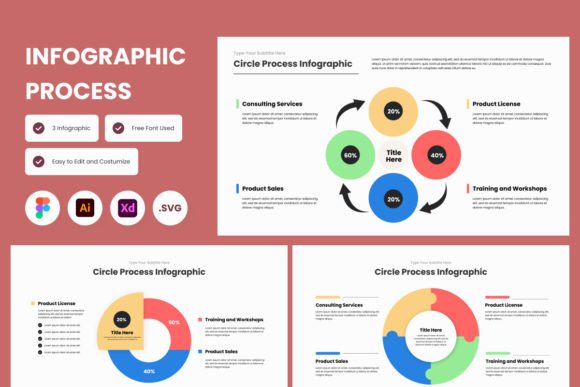
This bundle is built around a circular diagram format that typically accommodates three to six stages. The circular layout is particularly useful for processes that are ongoing, iterative, or cyclical. Unlike linear diagrams that suggest a start and end point, the circular structure emphasizes repetition, feedback loops, and continuous improvement.
You receive four Adobe Illustrator files and four EPS files, giving you plenty of flexibility depending on your preferred editing environment. The PNG high-resolution files come with a transparent background and no text or icons, so you can layer them into existing designs cleanly. A JPG preview image helps you quickly identify the version you need, and the Read Me file covers any setup details. The fonts used are free, the colors are easy to change, and the text in the diagrams is fully resizable. This means you can adapt the bundle to your own brand guidelines or presentation theme without starting from scratch.
Where the Circular Diagram Flow Stage Fits in a Broader Process
The circular diagram is not a standalone tool. It works best when integrated into a larger planning or communication workflow. Before you drop a diagram into a slide deck or a document, you need to have a clear understanding of the stages you want to represent. That means you will usually do some upfront work defining your process, identifying the key phases, and deciding how they connect.
Once you have that clarity, the diagram becomes a visual summary that you can use to communicate the process to others. After the project, you might revisit the diagram to document what actually happened versus what you planned, making it a tool for retrospective analysis as well.
Before a Project: Planning and Alignment
If you are preparing a project plan, the circular diagram helps you visualize the lifecycle early. You can map out phases such as research, development, testing, launch, and review. Each phase connects to the next, and the circular shape reminds everyone that the end of one cycle feeds into the beginning of the next. This is especially useful for teams that work in agile or iterative frameworks.
During a Project: Tracking and Communication
As the project moves forward, you can update the diagram to show which stage is active. This gives team members and stakeholders a quick reference point. Instead of reading a long status report, they can glance at the diagram and see exactly where things stand. The editable text makes it easy to add dates, milestones, or brief annotations.
After a Project: Review and Improvement
Once a cycle completes, you can use the diagram to facilitate a post-mortem or retrospective. Overlay actual timelines, note bottlenecks, or highlight stages that went particularly well. The resizable and editable format means you are not locked into a static design. You can adjust the diagram to reflect lessons learned and then reuse it for the next cycle.
Practical Implementation Tips
Getting the most out of the Bundle 3-6 Circular Diagram Flow Stage requires a bit of upfront preparation and some awareness of how the files work in different contexts. Here are several tips that will help you integrate the bundle smoothly into your routine.
Choose the Right File Format for Your Workflow
If you work primarily in vector editing software like Adobe Illustrator, the AI and EPS files are your best options. They preserve the full editability of shapes, colors, and text. If you collaborate with people who do not have vector software, the PNG files with transparent backgrounds work well for embedding into Google Slides, PowerPoint, Keynote, or even Notion pages. Keep the JPG preview handy for quick reference when you are browsing through your asset library.
Customize Colors and Fonts Early
Because the colors are easy to change, take a few minutes to align the diagram palette with your brand or project theme. This saves time later when you are inserting the diagram into a presentation or report. The fonts used are free, which means you do not have to worry about licensing issues if you share the file with clients or colleagues. If you prefer a different typeface, you can swap the text styling without breaking the layout.
Use the Transparent PNG for Layering
The high-resolution PNG files without text and icons are particularly useful when you want to overlay the diagram on a background image, a dashboard, or a printed handout. Because the transparency is clean, you can place the diagram over colored blocks, photographs, or textured backgrounds without awkward white boxes around the edges.
Workflow Examples Across Different Roles
The circular diagram flow stage bundle is not limited to one profession. Its flexibility makes it useful for a wide range of users. Below are a few examples that show how different people might integrate it into their daily work.
For Marketers: Campaign Cycles and Funnels
A marketing campaign rarely has a clean end. There is always analysis feeding into the next campaign, adjustments based on performance data, and new channels to test. You can use the diagram to represent the stages of a campaign: planning, content creation, distribution, monitoring, analysis, and optimization. The circular shape reinforces the idea that marketing is an ongoing process, not a one-time event.
For Educators and Trainers: Learning Modules
If you design curriculum or training programs, the diagram can map out a learning cycle. Stages might include introduction, concept exploration, practice, feedback, assessment, and reflection. Learners can see how each stage builds on the previous one and how the cycle repeats with new topics. The editable text allows you to customize the language for different courses or audiences.
For Freelancers and Creators: Project Lifecycles
Freelancers often juggle multiple projects at different stages. A circular diagram helps you visualize where each project stands. You might create one diagram per client or use a single master diagram and update the text as projects progress. The small file size and easy customization mean you can adapt the diagram without spending hours on design work.
For Small Business Owners: Operational Processes
Running a small business involves recurring tasks like inventory management, customer onboarding, order fulfillment, and follow-up. A circular diagram can serve as a visual standard operating procedure. New employees can quickly understand the flow of work, and the diagram can be posted in a shared space or included in a training manual.
Interacting with Other Tools and Methods
The Bundle 3-6 Circular Diagram Flow Stage works well alongside other planning and documentation tools. If you use project management software like Trello, Asana, or Notion, you can embed the PNG version directly into a project board or a documentation page. For presentations, the vector files give you crisp, scalable graphics that look professional on any screen size.
If you follow specific methodologies like Design Thinking, Lean, or Scrum, the circular diagram complements those frameworks nicely. For example, the Design Thinking process is often illustrated as a circular or iterative model with stages like empathize, define, ideate, prototype, and test. The bundle gives you a clean visual representation that you can customize to reflect your own adaptation of the methodology.
Organization and Long-Term Use
One of the practical advantages of this bundle is that it encourages consistency across your visual assets. When you use the same diagram template repeatedly, your audience starts to recognize the format, which makes communication faster and clearer. Store the AI and EPS files in a dedicated folder within your design assets library. Keep the PNG versions in a separate folder for quick access when you are working in non-vector applications.
Over time, you may want to create variations of the diagram for different contexts. Because the original files are editable, you can duplicate them and make adjustments without affecting your master template. This is especially useful if you work with multiple clients or departments that have their own color schemes and terminology.
Quality Control and Consistency
Before you finalize a diagram for public use, check that all text is legible at the intended display size. The resizable nature of the text helps, but if you shrink the diagram too much, small labels may become hard to read. Test the diagram on the medium where it will be used most often, whether that is a slide deck, a printed handout, or a web page.
Also, verify that the color contrast between the diagram elements and the background is sufficient. If you place the transparent PNG over a busy background, some segments might blend in. A simple adjustment to the background or adding a subtle shadow around the diagram can solve this.
Final Observations on Integration
The true value of the Bundle 3-6 Circular Diagram Flow Stage lies not in the files themselves but in how you use them to clarify your thinking and communicate with others. A well-designed diagram can turn a vague understanding of a process into a tangible reference point that everyone on your team can align around. It reduces the cognitive load of trying to hold a multi-stage process in your head and replaces it with a visual that you can point to, annotate, and revise.
Whether you are planning a new initiative, tracking ongoing work, or reviewing a completed cycle, having a reliable visual format at hand makes the process smoother. The bundle gives you that format with enough flexibility to adapt it to your specific needs, without forcing you to conform to a rigid template.
Take a few minutes to explore the files, customize the colors and text for your first use case, and then reuse the template as your needs evolve. Over time, you will find that the circular diagram becomes a natural part of how you plan, communicate, and improve your work.